 |
Electronic Components Datasheet Search |
|
|
Electronic Components Datasheet Search |
|
The question interval is too short.
Please try again in a few seconds.

Hello, Please ask a question about SL5504 Datasheet
# Example questions:
➢ What is the typical collector-emitter saturation voltage (vce(sat)) at a collector current of 10ma, according to figure 11?
➢ What package types are illustrated in the document, and what are the key dimensional characteristics mentioned?
➢ How does increasing the base resistance (rbe) generally affect the turn-on time (ton) as shown in figure 9?
| Part No. | SL5504 |
| Manufacturer | FAIRCHILD |
| Size | 524 Kbytes |
| Pages | 10 pages |
| Description | 6-PIN PHOTOTRANSISTOR OPTOCOUPLERS |




1. Device Description
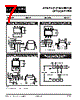
️· The document details the characteristics of four optocouplers: SL5500, SL5501, SL5504, and SL5511.
️· Optocouplers use light to electrically isolate circuits. This means a signal can be transmitted between two circuits without a direct electrical connection.
2. Key Electrical Characteristics (Highlights – there's a *lot* of data):
️· Input (LED) Characteristics:
- Forward Voltage (Vf): Typically around 1.2V to 2.2V (depending on the specific part and drive current)
- Forward Current (If): Typically specified up to 20mA, but can be higher in some conditions.
️· Output (Phototransistor) Characteristics:
- Collector-Emitter Breakdown Voltage (VCEO): Around 60V.
- Dark Collector Current (IC): This is the small current that flows through the phototransistor when *no* light is shining on it. It’s very sensitive to temperature (increases significantly with temperature).
- Gain (hFE): The ratio of collector current to base current. This is variable and not guaranteed to a specific value.
- Switching Speeds (Ton, Toff): Important for high-speed applications. Affected by load resistance (Rload) and base resistor (RBE).
️· Isolation Voltage: Specifies the voltage that can be applied between the input and output circuits without breakdown.
3. Switching Speed vs. Load Resistance (Rload) & Base Resistance (RBE)
️· These figures display the dependence of switching speeds (Ton, Toff) on Rload and RBE. Lower load resistance generally leads to faster switching speeds, but also higher power dissipation. Base resistance influences drive strength and switching speed.
️· Figures 9, 2, 12 show the dependence on RBE.
4. Dark Current vs. Temperature
️· Figure 12 demonstrates the strong dependence of dark current on ambient temperature. As temperature increases, dark current increases significantly.
5. Package Information:
️· The datasheet includes dimensions for both through-hole and surface-mount (SMT) packages.
6. Figures and Graphs (Key takeaways):
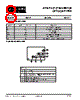
️· Figure 1: Typical Characteristics - shows LED forward voltage vs. current, output current vs LED drive current
️· Figures 2, 12: Dependence of switching speeds on RBE.
️· Figure 2: Dependence of switching speeds on Rload.
️· Figure 12: Dark Current vs Temperature.
Important Considerations & Notes:
️· Variability: The datasheet highlights the variability in parameters like gain (hFE). Optocouplers are not precisely manufactured components.
️· Temperature Sensitivity: Several parameters (especially dark current) are strongly temperature-dependent.
️· Safety Isolation: If using the optocoupler for safety isolation, carefully review the datasheet's isolation voltage specifications and relevant safety standards.
️· Application Notes: Review any application notes provided by Fairchild Semiconductor for best practices and circuit design considerations.
1. Device Description
️· The document details the characteristics of four optocouplers: SL5500, SL5501, SL5504, and SL5511.
️· Optocouplers use light to electrically isolate circuits. This means a signal can be transmitted between two circuits without a direct electrical connection.
2. Key Electrical Characteristics (Highlights – there's a *lot* of data):
️· Input (LED) Characteristics:
- Forward Voltage (Vf): Typically around 1.2V to 2.2V (depending on the specific part and drive current)
- Forward Current (If): Typically specified up to 20mA, but can be higher in some conditions.
️· Output (Phototransistor) Characteristics:
- Collector-Emitter Breakdown Voltage (VCEO): Around 60V.
- Dark Collector Current (IC): This is the small current that flows through the phototransistor when *no* light is shining on it. It’s very sensitive to temperature (increases significantly with temperature).
- Gain (hFE): The ratio of collector current to base current. This is variable and not guaranteed to a specific value.
- Switching Speeds (Ton, Toff): Important for high-speed applications. Affected by load resistance (Rload) and base resistor (RBE).
️· Isolation Voltage: Specifies the voltage that can be applied between the input and output circuits without breakdown.
3. Switching Speed vs. Load Resistance (Rload) & Base Resistance (RBE)
️· These figures display the dependence of switching speeds (Ton, Toff) on Rload and RBE. Lower load resistance generally leads to faster switching speeds, but also higher power dissipation. Base resistance influences drive strength and switching speed.
️· Figures 9, 2, 12 show the dependence on RBE.
4. Dark Current vs. Temperature
️· Figure 12 demonstrates the strong dependence of dark current on ambient temperature. As temperature increases, dark current increases significantly.
5. Package Information:
️· The datasheet includes dimensions for both through-hole and surface-mount (SMT) packages.
6. Figures and Graphs (Key takeaways):
️· Figure 1: Typical Characteristics - shows LED forward voltage vs. current, output current vs LED drive current
️· Figures 2, 12: Dependence of switching speeds on RBE.
️· Figure 2: Dependence of switching speeds on Rload.
️· Figure 12: Dark Current vs Temperature.
Important Considerations & Notes:
️· Variability: The datasheet highlights the variability in parameters like gain (hFE). Optocouplers are not precisely manufactured components.
️· Temperature Sensitivity: Several parameters (especially dark current) are strongly temperature-dependent.
️· Safety Isolation: If using the optocoupler for safety isolation, carefully review the datasheet's isolation voltage specifications and relevant safety standards.
️· Application Notes: Review any application notes provided by Fairchild Semiconductor for best practices and circuit design considerations.
| Part No. | SL5504 |
| Manufacturer | FAIRCHILD |
| Size | 524 Kbytes |
| Pages | 10 pages |
| Description | 6-PIN PHOTOTRANSISTOR OPTOCOUPLERS |
| Does ALLDATASHEET help your business so far? [ DONATE ] |
About Alldatasheet | Advertisement | Contact us | Privacy Policy | Link to Datasheet | Link Exchange | Manufacturer List All Rights Reserved©Alldatasheet.com |
| Russian : Alldatasheetru.com | Korean : Alldatasheet.co.kr | Spanish : Alldatasheet.es | French : Alldatasheet.fr | Italian : Alldatasheetit.com Portuguese : Alldatasheetpt.com | Polish : Alldatasheet.pl | Vietnamese : Alldatasheet.vn Indian : Alldatasheet.in | Mexican : Alldatasheet.com.mx | British : Alldatasheet.co.uk | New Zealand : Alldatasheet.co.nz |
|
Family Site : ic2ic.com |
icmetro.com |
 English ▼
  Chinese
 German
 Japanese
 Russian
 Korean
 Spanish
 French
 Italian
 Portuguese
 Polish
 Vietnamese
 Indian
 Mexican
 British
 New Zealand