 |
Electronic Components Datasheet Search |
|
|
Electronic Components Datasheet Search |
|
The question interval is too short.
Please try again in a few seconds.

Hello, Please ask a question about LTM4612 Datasheet
# Example questions:
➢ How does increasing the input voltage (from 24v to 36v) affect the efficiency at a load current of 3a for a 15v output?
➢ What is the typical transient response time for a load step from 0a to 4a with the specified output capacitors (1 × 47µf poscap, 1 × 10µf ceramic, and 3 × 47µf ceramic)?
➢ What is the primary purpose of the soft-start capacitor (e.g., 0.1µf) during startup, and how does it influence the initial inrush current?
| Part No. | LTM4612 |
| Manufacturer | LINER |
| Size | 637 Kbytes |
| Pages | 30 pages |
| Description | EN55022B Compliant 36VIN, 15VOUT, 8A, DC/DC μModule Regulator |





1. Device Overview & Purpose
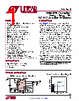
️· The document describes the LTM4613, a synchronous buck-boost DC/DC converter. This means it can produce an output voltage that is either higher or lower than the input voltage, which is a useful feature for various applications.
2. Key Features
️· Buck-Boost Operation: Can output a voltage higher or lower than the input.
️· Synchronous: Uses synchronous rectification, resulting in higher efficiency.
️· Wide Input Voltage Range: A wide range of input voltages can be accepted.
️· Adjustable Output Voltage: Allows for flexible design to meet specific needs.
️· Internal Compensation: Simplifies design and reduces external components.
️· Small Size: Integrated design minimizes board space requirements.
3. Electrical Characteristics (Key Values - full list in datasheet)
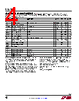
️· These are not explicitly listed in the text but implied by the charts. Refer to the datasheet for the complete specifications.
4. Performance Graphs & Charts (Summarized – refer to the original images for precise data)
The following summarizes the key trends observed from the graphs, organized by category. Remember to view the actual graphs for precise values and details.
A. Efficiency vs. Load Current
️· Multiple Input Voltages: The efficiency is shown for various input voltages (e.g., 12V, 15V, 24V, 28V, 36V) at different output voltages (12V and 15V).
️· High Efficiency: The device exhibits high efficiency across a range of load currents, typically above 80-90% under typical conditions.
️· Load Dependence: Efficiency increases with load current up to a certain point, then might plateau or slightly decrease at higher loads.
B. Transient Response (Load Step Changes)
️· Fast Response: The transient response graphs show how quickly the output voltage recovers after a sudden change in load current (e.g., from 0A to 4A).
️· Minimal Overshoot/Undershoot: The output voltage exhibits very little overshoot or undershoot during load step changes, indicating good stability.
️· Fast Settling Time: The output voltage settles quickly to the target value after the load step.
C. Start-Up Behavior
️· Soft-Start: The device uses a soft-start mechanism to limit inrush current during startup.
️· Fast Startup: Shows how the output voltage ramps up during startup.
D. Short-Circuit Behavior
️· Protection: Demonstrates the device's response to a shorted output.
️· Recovery: Shows how the device recovers from a short-circuit condition.
E. Input/Output Ripple
️· Low Ripple: Indicates that the device generates minimal ripple on both the input and output.
*Note - Ripple amplitude and frequency will change depending on component selection and operating conditions.*
F. Input/Output Voltage Step-Down Ratio
️· Demonstrates the operation with different input and output voltages.
5. Component Recommendations (Implied from graphs)
️· Capacitors: The graphs often show results with combinations of ceramic and electrolytic capacitors. Specific values aren't stated, but the results imply that a combination is used.
️· Soft-Start Capacitor: The graphs show a 0.1µF capacitor used for soft-start.
Important Notes:
️· Refer to the full datasheet: This summary is based on the provided text and images. The complete datasheet contains comprehensive specifications, detailed component recommendations, and application circuits.
️· Application-Specific: The actual performance will depend on the specific application circuit design, component selection, and operating conditions.
️· Graphs are Essential: The performance graphs (efficiency, transient response, start-up, short-circuit) are crucial for understanding the device's capabilities. The text summary is only a simplified representation.
1. Device Overview & Purpose
️· The document describes the LTM4613, a synchronous buck-boost DC/DC converter. This means it can produce an output voltage that is either higher or lower than the input voltage, which is a useful feature for various applications.
2. Key Features
️· Buck-Boost Operation: Can output a voltage higher or lower than the input.
️· Synchronous: Uses synchronous rectification, resulting in higher efficiency.
️· Wide Input Voltage Range: A wide range of input voltages can be accepted.
️· Adjustable Output Voltage: Allows for flexible design to meet specific needs.
️· Internal Compensation: Simplifies design and reduces external components.
️· Small Size: Integrated design minimizes board space requirements.
3. Electrical Characteristics (Key Values - full list in datasheet)
️· These are not explicitly listed in the text but implied by the charts. Refer to the datasheet for the complete specifications.
4. Performance Graphs & Charts (Summarized – refer to the original images for precise data)
The following summarizes the key trends observed from the graphs, organized by category. Remember to view the actual graphs for precise values and details.
A. Efficiency vs. Load Current
️· Multiple Input Voltages: The efficiency is shown for various input voltages (e.g., 12V, 15V, 24V, 28V, 36V) at different output voltages (12V and 15V).
️· High Efficiency: The device exhibits high efficiency across a range of load currents, typically above 80-90% under typical conditions.
️· Load Dependence: Efficiency increases with load current up to a certain point, then might plateau or slightly decrease at higher loads.
B. Transient Response (Load Step Changes)
️· Fast Response: The transient response graphs show how quickly the output voltage recovers after a sudden change in load current (e.g., from 0A to 4A).
️· Minimal Overshoot/Undershoot: The output voltage exhibits very little overshoot or undershoot during load step changes, indicating good stability.
️· Fast Settling Time: The output voltage settles quickly to the target value after the load step.
C. Start-Up Behavior
️· Soft-Start: The device uses a soft-start mechanism to limit inrush current during startup.
️· Fast Startup: Shows how the output voltage ramps up during startup.
D. Short-Circuit Behavior
️· Protection: Demonstrates the device's response to a shorted output.
️· Recovery: Shows how the device recovers from a short-circuit condition.
E. Input/Output Ripple
️· Low Ripple: Indicates that the device generates minimal ripple on both the input and output.
*Note - Ripple amplitude and frequency will change depending on component selection and operating conditions.*
F. Input/Output Voltage Step-Down Ratio
️· Demonstrates the operation with different input and output voltages.
5. Component Recommendations (Implied from graphs)
️· Capacitors: The graphs often show results with combinations of ceramic and electrolytic capacitors. Specific values aren't stated, but the results imply that a combination is used.
️· Soft-Start Capacitor: The graphs show a 0.1µF capacitor used for soft-start.
Important Notes:
️· Refer to the full datasheet: This summary is based on the provided text and images. The complete datasheet contains comprehensive specifications, detailed component recommendations, and application circuits.
️· Application-Specific: The actual performance will depend on the specific application circuit design, component selection, and operating conditions.
️· Graphs are Essential: The performance graphs (efficiency, transient response, start-up, short-circuit) are crucial for understanding the device's capabilities. The text summary is only a simplified representation.
| Part No. | LTM4612 |
| Manufacturer | LINER |
| Size | 637 Kbytes |
| Pages | 30 pages |
| Description | EN55022B Compliant 36VIN, 15VOUT, 8A, DC/DC μModule Regulator |
| Does ALLDATASHEET help your business so far? [ DONATE ] |
About Alldatasheet | Advertisement | Contact us | Privacy Policy | Link to Datasheet | Link Exchange | Manufacturer List All Rights Reserved©Alldatasheet.com |
| Russian : Alldatasheetru.com | Korean : Alldatasheet.co.kr | Spanish : Alldatasheet.es | French : Alldatasheet.fr | Italian : Alldatasheetit.com Portuguese : Alldatasheetpt.com | Polish : Alldatasheet.pl | Vietnamese : Alldatasheet.vn Indian : Alldatasheet.in | Mexican : Alldatasheet.com.mx | British : Alldatasheet.co.uk | New Zealand : Alldatasheet.co.nz |
|
Family Site : ic2ic.com |
icmetro.com |
 English ▼
  Chinese
 German
 Japanese
 Russian
 Korean
 Spanish
 French
 Italian
 Portuguese
 Polish
 Vietnamese
 Indian
 Mexican
 British
 New Zealand